Showing posts with label Pasta. Show all posts

Orecchiette con Cime di Rapa e Pecorino

Orecchiette con Cime di Rapa e Pecorino


Like so many traditional pasta dishes, this simple pasta recipe is made with only a few ingredients, and it is absolutely tasty! 

Orecchiette is a traditional pasta that originated in the region of Puglia, Italy. Orecchiette means “little ears” in Italian. Broccoli Rabe (rapini) is a slightly bitter dark green, similar to small broccoli, however it isn’t related to broccoli at all, it is in the turnip family. I cook my rapini and my pasta in the same boiling water. First, I boil the rapini, drain it, and then cook it in a skillet with olive oil and fresh garlic. I cook my pasta in this light green boiling water (rapini water) because of its nutritional value. If my pasta sauce is too dry, I add some rapini/pasta water to the sauce. No need for extra olive oil. The other key ingredient for this recipe is using grated Pecorino cheese instead of Parmesan cheese. The contrast of the rapini and Pecorino cheese is memorable. Try it!


Orecchiette


½ pound orecchiette pasta

1 bunch broccoli rabe (rapini)

2-3 cloves of garlic, peeled and crushed  

Pinch red pepper flakes

Extra virgin olive oil

Salt and black pepper

Grated Pecorino Cheese


Broccoli Rabe (Rapini)

1.     Rinse broccoli rabe under cold running water. Remove all yellow and dull leaves. Trim off the bottoms of the stems to remove tough and fibrous parts. Chop Coarsely.

2.     Put the broccoli rabe in a large pot of boiling water with salt. Reduce the heat to medium and cook for about 5 minutes. Remove the broccoli rabe, drain well and set aside.

3.     Return the pot to a full boil, add the orecchiette pasta in the same water and cook until pasta is “al dente.”

4.     In a large skillet pan add 2-3 tablespoons olive oil, pinch of red pepper flakes, crushed garlic, and salt and pepper to taste. Cook for 2 minutes, then add the broccoli rape in the skillet and cook for 5-6 minutes.

5.     Drain pasta and reserve some pasta water. Transfer pasta to the skillet with the broccoli rape and toss to combine flavors for a couple of minutes. Add Pecorino cheese and toss again, serve warm. 


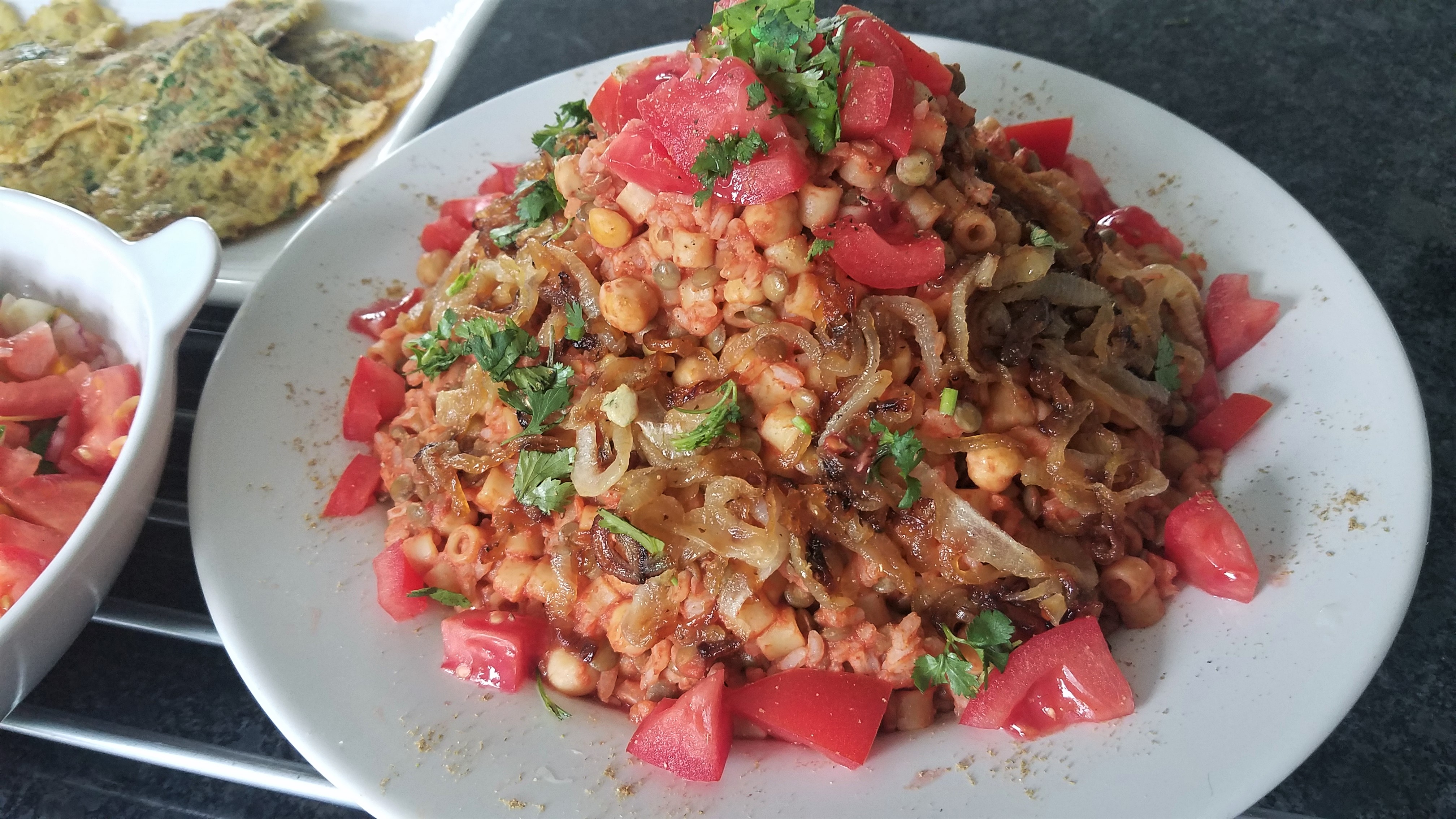
Koshari (Egyptian Comfort Dish)


Koshari 

Koshari is a typical dish of Egyptian tradition, a unique street food to be enjoyed at home. Its origin dates back to around 1800, when Egypt, an important crossroads of cultures and foods, experimented with this simple, varied, colorful and spicy dishes. It’s a substantially filling comfort food without the use of meat. Typical ingredients are chickpeas, lentils, rice, pasta, a special mixture of spices called Baharat, and caramelized onions.

Koshari

Crispy Onions:                                                                     

1 large sweet onion, thinly sliced rings                       

2 tablespoons extra virgin olive oil                                                 

Salt and pepper                                                        

Tomato Sauce:                                              

2 tablespoons olive oil                                             

2 cloves of garlic, minced                                                  

1 bottle passata tomatoes jar                                  

1 teaspoon ground coriander                                   

½ teaspoon ground cumin

Red pepper flakes

Salt and pepper

1-2 tablespoons distilled white vinegar (optional)

Koshari

1 ½ cups cooked brown lentils

1 ¼ cups cooked medium-grain rice

1 ½ cups cook ditalini or elbow pasta

1 (15 oz) can chickpeas, drained

1-2 tomatoes, chopped

Salt and pepper

½-1 teaspoon ground coriander

½ - 1 teaspoon ground cumin

Fresh cilantro to garnish

Preparation:


1.     Rice, Lentils, and Pasta: Rinse and cook lentils according to package directions. Rinse and cook the rice according to package directions. Cook the pasta according to package directions. Be sure to season all with salt.

2.     The onions:

Add the oil and onion rounds in a large skillet, cook on medium-low heat until soft and just golden. As soon as they begin to darken and caramelize, remove and set aside.

3.     The Sauce:

In the same skillet, add 2 tablespoons of olive oil, red pepper flakes and garlic. Cook on low heat for 45 seconds until aromatic. Add the tomato puree and spices. Simmer a few minutes. Taste for seasoning and adjust as needed. Add the white vinegar and cook 30 seconds if desired.

4.     Assembly:

In a large pan add the rice, lentils, pasta, chickpeas and tomato sauce. Add the coriander and cumin. Sauté everything over medium- high heat to mix and warm, be careful not to dry too much. Transfer the Koshari on a wide plate.

5.     Serving:

Garnished with reserved caramelized onion, cilantro, and tomatoes on top seasoned with salt and pepper.


Cooking for Ukraine with Chef Alba - Supporting World Central Kitchen

To register for this online cooking classes go to:

https://www.eventbrite.com/e/cooking-for-ukraine-with-chef-alba-supporting-world-central-kitchen-tickets-299096093467?aff=ebdssbonlinesearch


Join Chef Alba for an online cooking demonstration. All funds collected will be given directly to World Central Kitchen to support Ukraine.


About this event

Recipes included are Chicken Kiev with Roasted Garlic Butter and Potatoes Ukraine style. All funds collected will be given directly to World Central Kitchen. The World Central Kitchen team is distributing nourishing food and fresh meals across the region, including in Ukraine, Poland, Hungary, Moldova and Romania. The meals World Central Kitchen serves are primarily based on local recipes.

About Chef Alba: Chef Alba is a cooking instructor, a personal chef, cookbook author, recipe writer, editor and tester, and a food blogger with over 18 years of experience. Born in Naples, Italy and raised in Tunisia, North Africa, she gained practical knowledge of traditional techniques and ingredients which she shares with her students and clients. Alba’s expertise is in Regional Italian, Moroccan, Greek, Turkish, and other Mediterranean Cuisines. Alba is currently teaching virtual adult cook along classes for Howard County Parks and Recreation, various other venues, and privately. She also teaches in person cooking classes in Annapolis for Whole Foods. Alba has appeared on FOX DC, CBS DC, and PBS Virginia performing live cooking demos. She also conducts culinary trips to Umbria and Tuscany in the Spring and Fall of each year. Alba is a member of Les Dames d’Escoffier, and IACP (International Association of Culinary Professionals).

About World Central Kitchen: World Central Kitchen has provided tens of millions of fresh, nourishing meals for communities around the world. Your donation today will be used to support their emergency food relief efforts and resilience programs in Ukraine.

La Carbonara Pasta


Alba’s Spaghetti Carbonara Traditional Recipe -Spaghetti Carbonara is one of the most famous Pasta Recipes of Roman Cuisine, made only with 6 simple ingredients: spaghetti, guanciale (or Pancetta), freshly cracked black pepper, freshly grated Pecorino Romano, beaten yolks, and pasta water. All the ingredients must be of high quality to achieve a successful recipe. No garlic, no onions, no herbs, and no olive oil please!

The history of carbonara is relatively recent, and its origins are controversial, also because there is no written trace of it, or text of Italian or Roman cuisine that speaks of it. According to a first theory, Carbonara was born in 1944, during the Second World War, in a trattoria in Vicolo della Scrofa in Rome. According to another theory, the Carbonara would be the evolution of an ancient dish: "Cacio e Ova", that is, cheese and eggs, a dish prepared by the Carbonari when they went to the woods to make coal.

There are a few simple techniques to make a perfect Carbonara that I will point out.


La Carbonara

1 pound spaghetti

6 ounces of diced guanciale or diced pancetta

4 medium egg yolks, lightly beaten

1 ¼ cups freshly grated Pecorino Romano

Freshly cracked black pepper

Pasta: In a large pan boil water with 2 tablespoons of salt. When the water comes to a full boil, add the spaghetti. Stir for about 30 seconds so the pasta doesn’t stick. Cook until the pasta is al dente.  Remember before straining to save 1 ½ cups pasta water.

Eggs and cheese: While the pasta is cooking, place the yolks in a bowl and lightly beaten the yolks. Add the fresh grated cheese and mix together to form a paste.  Then scoop one ladle full of cooked pasta water into this bowl and quickly mix.  This is called tempering; it will prevent the egg yolks when added to the pasta to curdle.

Finishing the Sauce:

o   Put the guanciale or pancetta in a large skillet and cook until barely golden. Cook on medium heat.

o   Reserve your pasta water before straining. When the pasta is ready, transfer the pasta to the skillet with the guanciale or pancetta. Continue to cook on medium heat, Fold and mix well until the pasta is well coated.

o   Remove the skillet off the heat: Add the cheese and yolk mixture and quickly mix and fold to coat the entire pasta.  Add a ½ ladle of pasta water and mix again. If needed add ½ ladle of pasta water and mix and fold the pasta until just barely creamy. Lastly add freshly cracked black pepper.

o   Serve warm with more freshly cracked black pepper and a sprinkle of Pecorino grated cheese. This pasta is meant to be eaten right away. Enjoy it!

Pasta Al Profumo di Arancia 


Oranges are the coming together of two fruits, the pomelo fruit, and the mandarin. Oranges are native to China grown as early as 2,500 BC. When the Arabs conquered Spain in the 8th century they introduced oranges. Later they were introduced into Italy. In the 16th century, Spaniards took oranges to the Americas.  It was the Spanish Missionaries, and the Franciscans who began planting orange orchards in Arizona and California. Florida eventually became a big grower due to favorable conditions.

 What about the orange skin, the zest? 

The skin of the orange contains three times the vitamin C compared to its pulp.

Zest of orange is widely used in Italian recipes. Orange zest can be used to give an extra touch of flavor, and a different scent or aroma to everyday dishes. Of course, only the orange part of the peel (zest) should be used, because the white part has a bitter taste. The most common use for orange zest is to add it to cakes, custard, salads, pasta dishes or risottos, on fish or seafood, stews, in salted sauces or sweet creams, and tea infusions. The only time the orange and white part of the orange skin is used is to make a delicacy of candied the orange rinds.  

Here is one of my favorite recipes to make with orange zest and juice, “Pasta al Profumo di Arancia”. I hope you will enjoy it as much as I do.

Pasta al Profumo di Arancia There are endless preparations for pasta dishes.  I love to vary and experiment with new combinations or ways to present it. This is a simple, aromatic, and delicious dish, ideal to prepare for an improvised dinner or for a holiday.

Pasta al Profumo di Arancia

½ pound Tagliatelle or Parpadelle pasta 

1 tablespoon extra-virgin olive oil

1 tablespoon unsalted butter

1 medium shallot, finely minced

Zest in strips of 2 organic oranges (julienne style)

Juice 1 organic orange

4 fluid ounces heavy cream

Salt, freshly cracked black pepper, red pepper flakes

Minced Italian parsley for topping


1.        Cook the pasta according to package directions in salted boiling water. Reserve ½-1 cup of pasta water right before draining.

2.        Cut the orange peel into thin strips, avoiding the white part because it is bitter.

3.        In a large skillet, and the olive oil, butter, and shallot on low heat. Cook until the shallot is just golden.  Add the orange peels and cook 1-2 minutes until softened. Raise the heat to medium-low and add juice of 1 orange, cook until reduced by half.

4.        Add the cream and ½ cup of warm pasta water.  Cook 5-8 minutes until well blended and creamy.

5.        When the pasta is ready and drained, add to the skillet with the sauce and mix well. If too dry add a little more pasta water a few tablespoons at a time. Finish with lots freshly cracked black pepper and minced Italian parsley on top.


Pasta al Forno with Broccoli and Sausage

Pasta al Forno with Broccoli and Sausage


Pasta al Forno with Broccoli and Sausage is a simple and tasty first course. A great idea for Sunday lunch or brunch. Using easy to find ingredient and my simple techniques, the only thing you have left to do is, put it in the oven and wait to taste it.   

2-3 tablespoons extra virgin olive oil
1 sweet onion, diced
4 Italian mild or spicy sausages, remove casing
1 pound of broccoli, cut into florets
1 pound of penne or mezze rigatoni pasta
1-pound container whole milk ricotta
3 large eggs, lightly beaten
1- 1 ½ cups grated pecorino or parmesan cheese, divided
Kosher Salt
Black pepper
Red pepper flakes
3-4 tablespoons unsalted butter, cut into small cubes

Preheat oven to 350F.  Butter a baking pan, season with salt and pepper, and sprinkle it with a few tablespoons of grated cheese. (I always season the bottom of my pan for best flavor!)

Cooking the onion and sausage: In a large skillet on medium heat, add the olive oil and onion, cook until translucent. Add the ground sausage and cook until golden brown.  Season with salt, pepper, and red pepper flakes.

Cooking the broccoli: In the meantime, boil the florets in a pasta pan with a little salt, and cook until slightly crispy. Do not overcook. Strain with a hand strainer.  Reserve and reuse the broccoli water for the pasta.

When the sausage is cooked to golden, add the partially cook broccoli into the skillet.  Taste and adjust seasoning as needed. If the mixture is too dry, add another tablespoon of olive oil, and 1 or 2 tablespoons of warm broccoli water.

Cooking the pasta: Add the pasta to the broccoli water and cook according to package direction minus 2 minutes.  The pasta will continue to cook in the oven, so do not overcook. When ready, strain. Reserve 1/2  cup of pasta water if needed to mix with ricotta and eggs.

The ricotta and eggs:  place the ricotta in a bowl; whip it slightly.  This helps make the ricotta a little creamier.  Add the beaten eggs and mix.  Season with pepper.  Add the strained pasta in with the ricotta and egg mixture; mix well. if too dry, add a few tablespoons of pasta water as needed.  

Assembly: Layer half of the pasta mixture on the bottom of the baking pan, add a sprinkle of pepper,  and a few tablespoons of grated cheese.  Add all of the sausage and broccoli mixture on top;  add black pepper and a few tablespoons of grated cheese. Lastly, add the remaining pasta on top of the sausage and broccoli. Add more grated cheese on top of the last layer. Scatter small cubes of butter on top of dish to make it golden.  Bake until the top of the pasta is golden, about 25 minutes.

Enjoy and see you next time!

Carrot Soup Ginger and Potato

Organic Carrot Soup

 4 medium organic carrots, rinsed, peeled, and roughly chopped
1 sweet organic onion, roughly chopped
1 organic potato, peeled, roughly chopped
2 tablespoons extra virgin olive oil
Pinch salt
Black pepper
Red pepper flakes
1 stick cinnamon
1/4 to 1/2 teaspoon ground ginger
1-2 bay leaves
½ cup orzo pasta (optional)

In a food processor, add the carrots and onion. Pulse a few times until minced.
mince in food processor 

In a wide deep pan, add the olive oil, the minced carrots, and onion on medium-low heat. Cook about 5 minutes stirring occasionally until fragrant.

Add the chopped potato in the food processor, transfer to the pan with carrots and onion. Cook another 5 minutes.

Cook in skillet 
Add 2 cups of hot water and reduce liquid about halfway. Add 4 cups of hot water and bring to a boil. Simmer on low heat. Add the salt, pepper, red pepper flakes, cinnamon stick, ground ginger and bay leaves.

Cook on low heat, 10-12 minutes, taste for seasoning. Add the pasta if using; cook about 15-18 more minutes. When the pasta is done, the soup will also be done. If the soup is too thick for you add another ½ - 1 cup of hot water. When the soup is ready, ladle in a soup bowl and drizzle a thread of olive oil. Serve hot.


Carrots are one of the most versatile loved vegetables that can be eaten raw, or cooked. They are available year-round, and, in the kitchen, they can be used a thousand ways. They can be used in salad, soups, stews, pasta, cakes, and even bread.  This is an old simple Italian carrot soup recipe that I have updated to elevate the flavor using ground ginger and a cinnamon stick.  It is still a delicate soup that can be enjoyed by adults and children. 

If you do not have ground ginger, you can add ground nutmeg.  Whatever you do, keep it low salt so that you can enjoy the fragrance and sweetness of the vegetable.  


Handmade Pici with Fresh Tomato Sauce and Burrata


Pici (Pinci) Pasta, Fresh Tomato Sauce, Burrata
Pici is a thick, hand rolled pasta, similar to fat spaghetti. 
It originated in the province of Siena in Tuscany.
In the Montalcino area, it is called pinci. 
This is hearty pasta best served with
 a spicy tomato sauce or rich meat sauce.

Handmade Pici (Pinci) Pasta
3 cups unbleached all-purpose flour
1 small egg, lightly beaten
1/4 teaspoon salt 
1 cup room temperature water, plus extra if needed 
Extra virgin olive oil and semolina flour for tossing 

Place the flour and salt in a bowl. Add the egg and stir in the water; if the dough does not gather around the spoon, add a little more water by the spoonful until a dough forms. Knead the dough for 5 minutes, or until very smooth and pliable; the dough should be somewhat soft but not sticky. Flatten into a disk and rub both sides with olive oil. Let rest, wrapped in plastic for 30 minutes or up to 3 hours at room temperature.

Rub a work counter with olive oil. Cut the dough into 1/2 inch wide strips and roll each into a long, thin rope, using the palms of your hands. Each rope should be 1/2 inch thick. Toss each rope as it is finished with a little semolina flour and place on a tray in curling nests until ready to cook (the pici can be held at room temperature, covered loosely with a dry kitchen towel, for up to 3 hours). If you find that the dough resists and/or sticks to the counter as you roll it out, rub the counter lightly again with olive oil.
Fresh Pici Pasta
Fresh Baby Tomato and Basil Sauce
3 tablespoons extra virgin olive oil 
2 cloves garlic, thinly sliced
Salt 
Freshly ground black pepper
Red pepper flakes
1 pinch cherry or grape tomatoes, cut in half lengthwise
Freshly torn basil leaves
2 fresh burrata, cut in halves for topping

In large skillet add the olive oil and sliced garlic; cook 30-45 seconds on medium-low heat.  Add tomatoes and raise the heat to medium-high. Season with salt and peppers. Allow tomatoes to cook undisturbed for few minutes before turning.  Cook 6-9 minutes more until tomatoes wrinkle and some are golden.  Taste for seasoning; adjust with salt as needed. When the sauce is ready, add in the fresh basil.

Assembling the pasta and sauce: Cook the pici in boiling salted water until al dente.  Strain well and return to pan. Mix a little sauce in the pan with the pici.  Gently fold. Serve in individual plates with a little sauce on top, fresh basil and ½ of a fresh Burrata mozzarella. A drizzle of aged balsamic, optional.  Serves 4.

Fresh Burrata

Spaghetti al Vino Bianco e Arugula

Spaghetti al Vino Bianco e Arugula 

1 pound dried spaghetti
3 ounces minced pancetta 
2 cloves garlic, thinly sliced
2-3 tablespoons extra virgin olive oil                                                        
2 cups dry white wine, divided
Salt
Black pepper
Red pepper flakes
1/3 cup heavy cream                                      
1/2 cup freshly grated Pecorino cheese, more for topping               
5 ounces baby arugula, roughly chopped
1/4 cup toasted pine nuts, roughly chopped
15-20 pitted black olives   

Add 5 quarts water to large pot, add 2 tablespoons of kosher salt; cook over high heat.  When water comes to a full boil, add the spaghetti and until al dente. Note: set aside 1 cup of pasta water before straining.

In a large skillet, add the pancetta; cook over medium heat until crispy, 4 to 5 minutes. Remove from pan using a slotted spoon and set aside.  Add the garlic and the oil to skillet; sauté on medium-low heat until barely golden.  Add 1 to 1 1/2 cups of wine to skillet with garlic. Raise heat to medium-high for 6 to 8 minutes or until wine has reduced by half. Season with salt, pepper and red pepper flakes.

When the pasta is ready, strain and transfer to the skillet with the garlic. Add another ½ cup of white wine to skillet; cook until the wine has been fully absorbed, tossing the spaghetti constantly.   Add the cream, the grated cheese; toss to combine. Taste for seasoning and adjust as needed. Use pasta water if too thick: add a little at a time. Finish by adding the crispy pancetta, arugula, and pine nuts and fold to combine.   Top with the black olives. 
  
Country Side of Orvieto where the grapes grow
 Those who love good food know how to appreciate it, especially in the simplest forms. With just a few easy steps, you can prepare this delicate and elegant recipe. My white wine of choice is the Orvieto White.  You can use a Pinot Grigio if you prefer.